

Back to Harbor
On fear, ego death, and returning to the corporate world.

I have a new job. A new job in an old world.
The kind of job where I Slack more often than I breathe, inbox zero is a pipe dream, and I’m selling technology that, explained to the lay person, would reveal the whites in their eyes.1
It’s been a few weeks, and the experience has been as disorienting as what I’d imagine astronauts must feel when they come back to Earth. Pleading with my muscle memory to help me remember everything from talking to customers to making office small talk. There’s been a lot of second-guessing and under-breath pep talks.
I didn’t think I’d be here again. A year ago, I didn’t want to be in this scenario. But life has a way of setting the perfect stage for our ego death, and my case is no different. The curse of being a writer is that I think in terms of narratives. I was building this epic lore of the salesman turned writer, the man who gave the bird to glistening skyscrapers, corporate cushiness, and a steady paycheck, and who went on to write and live well. The resistance to returning to a 9-to-5 driven by a fear of betraying myself and my new emerging plot line. After all, what I’ve done is the equivalent of the hero embarking on a new adventure, and a few chapters in declaring “nah, I’m gonna just go back to the main harbor.” The about-face doesn’t really make for a compelling plot.
Why would I go back to a world I chose to leave on my own terms with the intention of not going back again? It’s not like being a white-collar worker has become idyllic over the past few years. We face a present where employers are salivating at the opportunity to replace us with AI tokens and chat windows. Daily office life is still ruled by absurd metaphors that create a false sense of urgency (“I need you to put out this fire,” “we need to triage this,” “this is DEFCON 2”). Firefighters we are not.
The answer is: Because I was afraid. I’ve tried writing my way around this for days weeks now, but I’m trying this cool new thing where I’m honest with myself for a change even if I hate the answer.
What am I so afraid of?
Let me take you to Colombia.
Colombia, September 2025
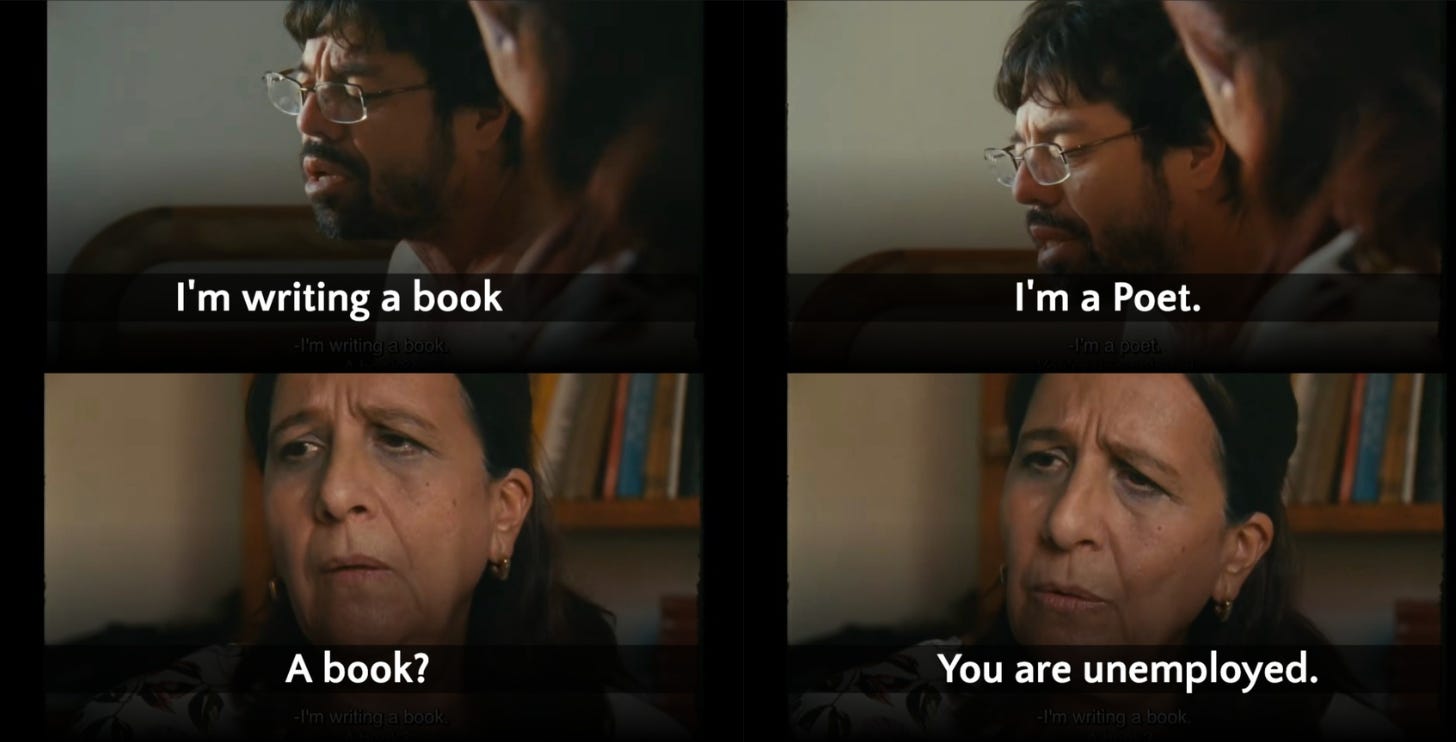
My Mom and I plunked down onto the rose-red chairs of my childhood movie theater in Bogotá with about five other people. I insisted that we watch a Colombian dramedy titled “Un Poeta” (A Poet), for the mere reason that it had “poet” in the name and an inkling that I would find some relation with the character.
The movie told the story of a middle-aged poet called Oscar Restrepo meandering through life between drunken streaks and a fruitless quest for relevance, in the process making his life more tragic than it already was. This is a story about someone’s hitting rock bottom, and then hitting deeper rock bottom. I didn’t see myself as a carbon copy of this sad poet, but I sensed the rhyme in his circumstances and mine.
A few days later, I picked up a graphic novel about Gabriel Garcia Marquez’s life. It described the time when Gabo lived in Paris, staying in an attic and picking up recycling on the street to earn some cents. Or how he and his wife Mercedes basically sold everything to send the manuscript for One Hundred Years of Solitude to a publisher in Argentina in two halves (since they couldn’t afford to send it all in one package).2
Oscar’s mediocrity and Gabo’s plight haunted me. They felt like premonitions. Both tales converged under a possible timeline where trying to endure like Gabo would lead me to Oscar’s sad life. I was afraid to become a casualty of artistic martyrdom.
The Alternative Paths
The myth of the starving artist that breaks through and makes it. The legend of the little creator that could. The parable of the rat race escapee finding joy and wealth. These are alternative narratives to the conventional path; the one that tells you to go to school, get good grades, get a good job, start a family, work until 65, retire.
I’m grateful that in the past few years I discovered that these alternative life stories exist, that there’s more than one way to live and that deviance from this path is not a moral failure. But these stories have hidden costs, tradeoffs, and omissions, which revealed, make them less appealing than initially presented.
Seldom do you see many of the alternative life path influencers talk about their inherited wealth, their male privilege, their pretty privilege, and any other advantages derived from inalienable characteristics. Or the significant survivorship bias that exists behind the “Here is how I made $1M through brand deals promoting Baboon sweat face creme” posts. These things matter. Not everyone who seeks an alternative way to financial sustainability and fulfillment gets to their desired destination—at least the first time.
I wanted to be one of these heroic characters, the captain of my own destiny, not a castaway holding on for dear life off a mahogany plank. This desire turned the so-called pathless path into a path itself. I wanted to be in the cool kids’ club of riches under my own terms. Of course, any setback on my quest was amplified against the magnitude of my expectations. Morgan Housel says that true happiness is results minus expectations. Well, my expectations were off and I felt dejection compounding every time I published the thing that would surely go viral, only to receive the equivalent of a lonesome clap.
My ego death was realizing that I had traded one path for another, yet was still a prisoner of expectations.
Play your game
I made a decision based on fear. But that’s not the whole story; decisions are rarely made through one emotion operating at 100% and overriding others.
I feel excited by the challenge to see if “I still have it,” whether I come back like Michael Jordan post-baseball-career break. I’m relieved that I can decouple my writing from financial gain. I’m also aware that in this job market, I bounced back into the corporate world as easily as I did. I don’t take that for granted. But mainly, I feel a sense of calm—every day I hear a voice that says “you are where you are supposed to be right now.”
This new chapter opens more questions; it puts me back in proximity with some old demons: fear of losing my essence, of my light being dimmed by corporate drudgery, of measuring my worth based on my sales performance. A constant theme I’ve observed is that the problems never go away; the best we can hope for is to choose the problems we want to face, and from there on: It’s either a good story or a good time.3
What do you mean you are not interested in hypertenancy, morsel-driven parallelism, and dual execution?
Mercedes famously told him: “Hey, Gabo, all we need now is for the book to be no good.”
Hopefully both.
Been here too! I quit my job and went traveling in 2013 thinking I would not go back to the corporate world I left. Then in 2015 I started at Amazon. In 2023 I had another similar period and started on the writing journey, only to discover the whole package of that lifestyle didn’t fit me in a lot of ways (self-promoting, working mostly alone, etc).
I believe we think, we try, we learn, we adjust. We’re afraid. We try again. Hopefully, we grow.
This is the type of post that only you can write—bravo on the storytelling. I found myself trying to pinpoint "what is this fear Camilo is talking about?" And realized that it really is a bit of fear from all angles and sides, which resonates with my experience:
- Fear of going back to corporate, but
- Fear of betraying your artistic ambitions, and
- Fear of what pursuing those ambitions might mean
Whether that's what you meant or not, reading this helped me map different parts of the experience that I've gone, and will surely, go through in cycles.
If it's one thing I can offer, it's that framing one's life in seasons has helped me. I'm in a season of exploration and de-centering work. For you, you got to experience an extremely unique season of the pathless path that most working folks don't get to experience.
Thanks for writing this!