

Negative Capability
A Lesson from Keats

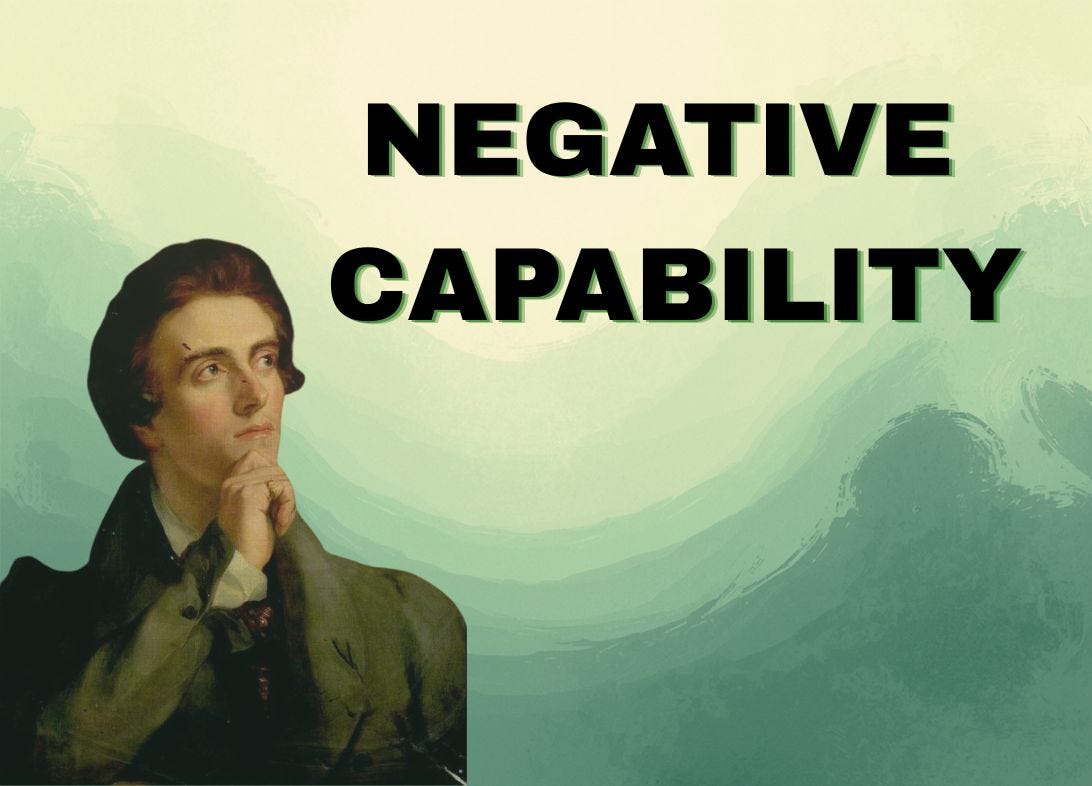
In an 1817 letter, the British poet John Keats coined the term “negative capability.” He defined it as the capability of “being in uncertainties, Mysteries, doubts, without any irritable reaching after fact & reason.”
I’ve been thinking about this term since I first heard of it in one of Rosalia’s interviews promoting her album “Lux.” She attributed Keats’ term as an influence in her latest work and general approach to life. This term is also explored in an old post from The Marginalian.1
This term captures fairly well my mental state as I reflect on last year and how I’m approaching 2026.
2025 was an odd year for me. I started it with one intention and ended with another. I had certain hopes and expectations, which did not materialize. I’ve made decisions which to most sidewalk observers would seem like regressions.
I started the year zealous about freelance writing and extending the mainsail of “getting paid to write is getting paid to do what I love.”2 In 2026, I’m scouting LinkedIn job postings like a theater cast list.
I thought 2025 would be the year where I consolidated my writing, earned enough loyal readers to fill out Benaroya music hall, and wistfully refer to 2025 as the year my writing truly evolved, bridging the proverbial “gap” that Ira Glass talks about in the now famous musing on taste and creation. Yet, my writing has become sparse, as many of you have noticed—and remarked with the same politeness taken when telling someone that their fly zipper is down.
These situations, these regressions, have filled my life with uncertainty. Was 2025 “rock bottom”?3 Or in the fog of my circumstances am I still riding a streetcar named desire, steering towards a boulevard of broken dreams?
Oddly enough, the question itself doesn’t awaken the same sort of balmy hands and insomnia that these types of anxieties surfaced years prior. Part of me believes that, no—yes, I should absolutely be pressing the panic button now and reduce uncertainty, and search, search for answers; reason my way out of my doldrums. There is a latent fear that I end up like Ignatius Reilly, the grotesque anti-hero in John Kennedy Toole’s A Confederacy of Dunces; hardly able to keep a job, dedicated to writing about obscure medieval history, while his Mom is exasperated with her son’s mediocrity and lack of empathy.4
Yet, I’ve become more “chill” with not having everything figured out.
I’ve been reading Oliver Burkeman’s Meditations for Mortals. There is one passage that encapsulates my evolving relationship with uncertainty:
“the driving force of modern life is the fatally misguided idea that reality can and should be made ever more controllable — and that peace of mind and prosperity lie in bringing it ever more fully under our control. And so we experience the world as an endless series of things we must master, learn, or conquer.”
This is not to say that I’ve shifted my approach to “jesus take the wheel” mode. Life requires agency, it rewards intrepidness and action. But for so long I’ve tried to bring things under my control—my career, my relationships, the world—with more frustration than success. Reducing uncertainty and bringing things under my control became a game of whack-a-mole where the number of holes doubled at every blink.
Building negative capacity is a tough task worth embracing. It sure beats leaving my relationship with uncertainty unexplored, lest I allow it to kindle a myriad of anxieties and compulsions I concoct and then try to escape from.
And escape I do. Daily. I indulge in the escapism offered by social media and the Internet, which allows me to conveniently ignore the tensions that arise, in the process shortening my attention span, which makes it harder to sit with any feeling. This is how we begin living superficially; trading awe for scrolls and falling into clichés of every kind because we’ve become unable to think about things with enough depth to form original thoughts.5
So my efforts to improve my negative capability have also become a mission to lengthen my attention span, to avoid tapping out whenever I feel fear or discomfort, and to go beyond the superficial in my thoughts and appreciations of everything around me.
*****
Near the end of Meditations, Burkeman asks us to imagine the lives of our medieval ancestors:
“In those days, you couldn’t ever have known with confidence what caused a famine or an outbreak of disease, nor felt reassured that a total eclipse didn’t presage the end of the world. Our ancestors’ inability to find the why with precision would have accustomed them to move through life enveloped in uncertainty about almost everything that was going on, or what might happen next.”
Perhaps this medieval bit of wisdom is what Keats had in mind when penning this term, and this whole piece is essentially a monologue where I tell myself “I’m learning to be ok with not knowing everything” — a hard thing for an overthinker-not-anonymous.
But I also think there is something about negative capability in demanding our attention, seeking depth in our thoughts, even our darkest ones, and not swiping it away as if we were closing an app on our phone. Negative capability is the refusal of irritable reaching for fact and reason. It invites us not to reach, but to learn to sit. To accept that fact and reason may have a place, but when it comes to just plain ol’ living, being is the simplest and hardest thing to do.
“When I have fears that I may cease to be” by John Keats

When I have fears that I may cease to be
   Before my pen has glean’d my teeming brain,
Before high-piled books, in charactery,
   Hold like rich garners the full ripen’d grain;
When I behold, upon the night’s starr’d face,
   Huge cloudy symbols of a high romance,
And think that I may never live to trace
   Their shadows, with the magic hand of chance;
And when I feel, fair creature of an hour,
   That I shall never look upon thee more,
Never have relish in the faery power
   Of unrelenting love; – then on the shore
Of the wide world I stand alone, and think
Till love and fame to nothingness do sink.
One of the very best blogs that have ever existed created by the wonderful Maria Popova.
I’m reminded by that viral clip from a Kim Kardashian interview where she feigns wisdom by saying: “Don’t love your job, job your love,” with top notch comments like: “don’t face your fears, fear your face,” “don’t waste your time, time your waste,” or “don’t crack your fingers…” I’ll let you finish that one.
Relative to the challenges that many people in the world experienced last year, close friends included, I’m well aware that my rock bottom may only be a couple feet deep.
Yea, yea, I know I’m not like that, but I would be lying to you if I told you that I didn’t read this book without thinking about how I related to this character.
And I fear the ways we people are defaulting to use AI for don’t make matters better.
Perhaps the ultimate lesson...
Great reflection, and major respect for continuing to examine your own narrative and orientation toward circumstance.
We’re still toddlers in this space that’s barely older than a toddler itself. I totally relate to this. It’s so easy to put so much importance and optimism in one year but we really spend our wholes lives figuring it out. At least another decade. Then we get bored, forget all this chaos and start again.