


Note: La versión en español de este ensayo se puede encontrar aquí.
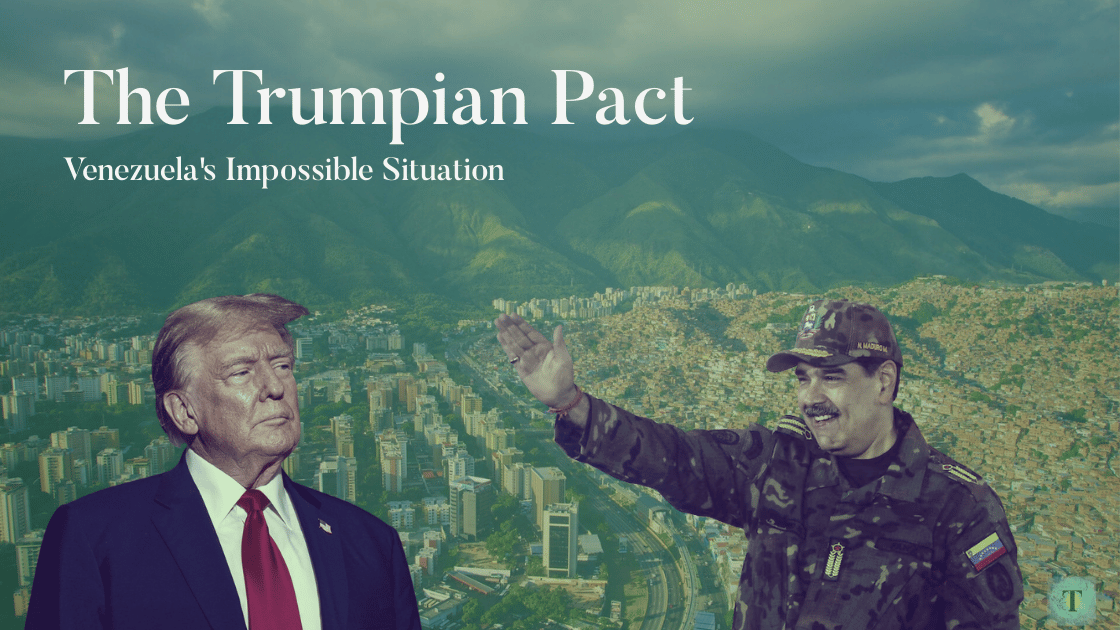
Milan Kundera wrote that man desires a world “where good and evil can be clearly distinguished, since we have an innate and irreversible impulse to judge before understanding.”
The situation in Venezuela is impossible. Between a rock and a hard place. Between Trumperialism and The Cachapa Tyranny. Good and evil don’t exist as opposite poles. There are no heroes here, much less liberators. The “savior” isn’t Simón Bolívar, but someone with the characteristics of Jabba the Hutt.
The earthquake Trump unleashed with the capture of Nicolás Maduro will shake Latin America from Tijuana to Patagonia. A region that still shows the scars of colonialism and feels their sting with another intervention from an empire.
I think a lot about the legend of the “Faustian pact” about a man who sells his soul to the devil in exchange for all the knowledge in the world. The phrase comes to mind when I think about Venezuela’s situation. And as much as it pains me, I fear Venezuela had no alternative but to accept a Trumpian Pact.
In Venezuela’s situation there are contradictory dualities that are simultaneously true. The tension generated by confronting the complexity of these elements feels like a crab’s pincers squeezing my temples. What I offer is a look beyond the “USA bad” or “Maduro good” narrative, which are so simple they sound good for Instagram, but add no critical understanding of the situation.
The Situation
The United States’ objective is oil. Let’s not kid ourselves. Everything else is an excuse based on half-truths or blatant lies. What the Trump administration seeks is to promote a ruler willing to reestablish relations with the United States and willing to give the U.S. priority access to the world’s largest oil reserves.1 Barrels in exchange for freedom.
To achieve this operation, the Trump administration has skipped all established processes in American politics for undertaking this type of operation (which to be fair has been largely ignored by both parties for decades). What results from this operation is that today, the United States and its institutions are weaker, and Trump’s autocratic power continues to consolidate. Furthermore, the operation is part of the smokescreen Trump wants to create to distract the American people from his government’s shortcomings2. Clearly I’m not a fan of Trump, his lies, his narcissism, his brazenness, or his lack of respect for institutions. He’s an agent of chaos with the primary goal of enriching himself and those he considers loyal to him.
That said, we arrived at this situation largely because Nicolás Maduro’s dictatorship stole the elections despite the opposition candidate Edmundo González (with the disqualified María Corina Machado behind him) winning them. The Venezuelan opposition, shrewd in anticipating the regime’s tricks, managed to obtain copies of the voting records to corroborate their clear victory. So overwhelming was the evidence and the CNE’s lack of transparency (the entity that regulates elections and is under regime control) that both the Carter Center, which was designated as an international observer under the 2023 Barbados Agreement that Maduro’s government signed, and the UN determined that the elections cannot be considered democratic, with the Carter Center declaring the election a “serious violation of electoral principles.”3
Much has been said about the violation of international law and a people’s sovereignty with this U.S. military action. I agree that international law was violated. But a country’s sovereignty is lost when the people’s will is ignored. What legitimacy does a government that wasn’t elected have? What sovereignty exists if power is usurped through lies and repression? If we demand that the sovereignty of the Venezuelan people be respected, where was that demand in 2024?
For Maduro, the Biden administration's support of the Barbados Agreement that the dictatorship signed with the opposition gave him a viable exit ramp. To incentivize his signature, the Biden administration returned a key regime player, Alex Saab, today Venezuela's industry minister and a shady figure associated with the regime's corruption and money laundering. Maduro committed to free elections with international observers. Maduro broke his word, disqualified Machado through tricks, and destroyed any legitimacy of the democratic process in 2024.
Naturally, the response from much of the left has been a visceral repudiation of this intervention. And I understand it.
#HandsOffVenezuela
I understand the desire to say #HandsoffVenezuela, to protest imperialism, and demand that the sovereignty of people in Latin America to be respected. I share that position and view U.S. intervention with dismay.
But the question I’ve asked myself during recent weeks anticipating this event is the following: when we talk about #HandsoffVenezuela, whose hands are we talking about—those of a regime whose hands have been stained with so much blood they’re now red? Or the gringo government, desperate to dip its hands into all that black gold?
How can one argue for the sovereignty of a people subjugated for decades under a government that destroyed the economy, the institutions, the electoral process, and as a result caused the diaspora of more than 8 million Venezuelans, or 25% of the country? Can one say things are going well when 25% of the country flees? Is it coherent to say the diaspora is due to U.S. sanctions (a highly contrived line of argument that curiously ignores Venezuela’s economic and social reality before the 2014 sanctions)?
What alternatives remained?
The democratic path was extinguished. Maduro closed that door by becoming drunk on power and his own narcissism.
The other viable option could have been pressure from the international community, particularly in Latin America. But the governments that today denounce and scream about U.S. intervention in the region abdicated their responsibility with tepid declarations and no clear demand that the people’s will be respected.
Lula of Brazil asked for the voting records, the dictatorship never presented them, and Brazil chose not to escalate repercussions against the regime beyond expelling it from the BRICS alliance (which doesn’t really harm the dictatorship). Sheinbaum in Mexico limits herself to “no comment,” choosing neutrality in the face of the regime’s human rights violations and delegitimization of democracy. And Petro in Colombia, who until recently dared to say Maduro was a dictator, maintains a close relationship, well documented, with Chavismo, despite the fact that the dictatorship is one of Colombia’s greatest security threats, since it shelters the ELN on its border, the guerrilla group that under Petro’s government has grown its territorial presence by 22%.4 Maduro’s counterparts decided to wash their hands and look the other way, when it was their responsibility to maintain the region’s sovereignty.
The only remaining option was civil conflict, for the Venezuelan people themselves to take up arms to remove Maduro from power. But for me it’s impossible, as a Colombian, to propose civil war as medicine. An armed conflict in Venezuela would be chemotherapy that would plunge the country into decades of misery. It’s not a viable option.
The Chavista regime has been terrorizing Venezuela for over 25 years.5 They destroyed the institutions, the country’s productive capacity, freedom of the press, freedom of expression, the judicial system, the separation of powers, the integrity of the democratic process, respect for private property, the dignity of the poor, the faith of all those people who voted for Chávez because Venezuela did need a government that respected and cared for the most oppressed and humble people... but not at the cost of destroying the entire country.
And I see the same pattern beginning in the United States. For me the parallels between what we’ve seen with Venezuela and what I watch with horror in the Trump administration are clear: In his second term, Trump has weakened institutions, consolidated executive power, affected the country’s productive capacity through senseless tariffs, and established corruption and enrichment of his inner circle as if it were a casual occurrence that shouldn’t be questioned.
The Aftermath
Now I’m not so naive as to think that now that Maduro is gone, rainbows will return, macaws will fly in jubilation and parrots will scream “freedom!” We’ve reached Venezuela’s most fragile point since April 11, 2002.
American intervention martyrs Chavismo, gives wings to the narrative that the United States is interventionist and given Trump’s comments during his address to the nation, make it really easy to characterize the US government as the villains from Avatar. The martyrization of Chavismo could unleash an internal conflict, that war, that chemotherapy I so dread.
It could give Trump wings to continue his brazen intervention plan as a smokescreen, and do the same thing in Colombia, where he has a president with a profile very similar to Maduro’s (and also a personality very similar to Trump himself). Colombia is not Venezuela, but unfortunately Petro’s government, objectively, did bring us closer to the Chavismo that strangled Venezuela.
Or worse still, I fear that individuals in Maduro’s regime are willing to negotiate with Trump to let them stay in power while they give the United States access to oil reserves. This would be the worst case scenario, but viable since Trump doesn’t care much about democracy.
My main fear is that in the long term a new oligarchy will consolidate with more affinity to the United States that essentially steals Venezuela’s resources and keeps them in a fragile recovery that makes people think that, yes, democracy and institutions returned, but what for if the elite still keeps stealing everything.
This pattern isn’t hypothetical. It’s the pattern Colombia knows well: we change governments, sign agreements, promise reforms, and wealth concentration barely moves. It’s changing one group of thieves for another group of thieves with better branding.6
What good did it do Venezuela to organize, win the elections, preserve the voting records, do everything right, if in the end the “freedom” they recover is only the freedom to choose between oligarchs? That would leave us at the same starting point as Chavismo. This cycle cannot be repeated, neither for Chavismo nor for the circumstances that gave wings to that movement.
Now there are also consequences for the world. I don’t buy the argument that because the United States now operated militarily in Venezuela, that gives the green light to other titans like Russia and China to do the same. Sorry, but Russia and China have operated with a green light for decades. In Russia’s case, did we forget about Georgia, or Crimea, before the invasion of Ukraine with the aim of annexing it territorially (a distinction versus the U.S. agenda)? Or what about China? We’ve focused so much on the constant threat and explicit desire to retake Taiwan but we’ve forgotten how it illegally annexed Tibet under international law and how it’s using its economic power to subjugate much of African territory through its new silk road where they use debt as an economic weapon to gain control?
The immediate international consequence is that this makes it very clear that the UN lacks any power to counter any action that violates human rights and international law. I’d even say that became clear when despite the almost unanimous UN consensus about the massacre in Gaza at Israel’s hands and evidence of crimes against humanity, both Israel and the United States haven’t suffered consequences for Gaza’s total destruction.7
The questions about international precedents and sovereignty are valid. They’re the questions I’ve been asking myself for several weeks. But I return to the same point: what precedent was created by letting Maduro steal the elections with evidence of that theft? What sovereignty exists when a people’s democratic voice is silenced at gunpoint with lies?
Listen to the People
Venezuela, in a way, is that ghost of the future from Charles Dickens’s book A Christmas Carol. I ask those who today say #HandsOffVenezuela: if this were the United States, covered in the ashes of a destroyed country, wouldn’t you want a Deus Ex Machina, a miracle that puts an end to the dictatorship?
Let’s imagine that Trump’s coup attempt on January 6, 2021 had been successful. Could we then say the United States would be legitimately governed by Trump? Could one say it would be a sovereign country if Trump had taken office illegally? What’s the difference between this hypothetical scenario (which fortunately didn’t happen) versus what did happen in Venezuela?
There are many who forget the dead, those disappeared by Chavismo. Let’s not forget them. Let’s not forget those who today are in El Helicoide, the dictatorship’s torture headquarters. Let’s listen to the victims, to all the Venezuelans in the diaspora who long to return.
Before formulating any flash opinion to feel part of the conversation on social media or out of pure instinct to resist Trump, it’s worth asking how much you know about the Chavez/Maduro dictatorship, the way institutions were destroyed, the right to private property, and how they persecute, lie, and torture. So far I haven’t seen a SINGLE Venezuelan who isn’t celebrating Maduro’s departure, even though they themselves are aware that everything isn’t resolved, and many of them don’t have any affinity for Trump.
I admit this situation leads me to an internal conflict where I feel rage and relief, concern and satisfaction. The situation is impossible, but the Venezuelan people deserve a country worthy of their greatness, their beauty, the warmth of their people and their grace. And I hear their jubilation, the jubilation of the dictatorship’s victims, and it’s hard for me to impose my vision of the perfect way to execute a change of government against the tears of a people who have run out of food and tears.
I do ask for #HandsOffVenezuela, but let’s start with the hands of Maduro’s dictatorship.
The fact that in his press conference on Saturday, January 3, he showed some doubt in backing Machado (and Edmundo González) is concerning as it breaks any argument that the U.S. seeks to reestablish democracy.
And The Epstein files. If, at this point, seeing all that we have seen (or all that’s been covered up), you do not believe that Trump’s relationship to Epstein was close and also troubling, then you just operate in a different reality and there is not much I can say to you.
Carter Center Report: According to Venezuelan law, electoral observers from the parties have the right to receive official copies of the voting records. Opposition observers collected records from 80% of voting centers; these records showed that opposition candidate Edmundo González Urrutia obtained an overwhelming majority of 67% of the votes. However, Venezuela's National Electoral Council made a single announcement on election night, merely declaring that Maduro had won. It did not provide results from the country's 30,026 voting centers.
From 189 municipalities in 2022 to 231 in 2025. Source: Defensoría del Pueblo de Colombia
And let's not forget that Chávez staged a failed coup in 1992 against a legitimate government that ultimately left more than 300 dead. Curious to call those celebrating today coup plotters while Chávez's relevance as a political figure in Venezuela is due to this failed coup attempt.
Key example: the current Colombian government and the number of corruption scandals and investigations. Colombia's problem isn't left or right; it's a political class and oligarchies that exploit the country's clientelism and informality to plunge it into a paralysis that prevents Colombia from realizing a potential that would benefit everyone.
Note, the Gaza situation is another of those impossible situations... and I'm of the opinion that Hamas is a terrorist group whose goal isn't freedom but its self-preservation as Israel's antagonist with the objective of its destruction, and at the same time that Israel's response in Gaza was disproportionate, vile, and in clear violation of human rights. Again, it's not a story of heroes and villains. And at the end of the day, as in any war, it's the people who suffer.
Thank you for taking the time to write this and for educating us on the nuances of this situation. I come from a (very) small country and our history books have always emphasised the importance of remaining independent. The section on why #HandsOffVenezuela and civil conflict aren't good options was thought-provoking for me.
…amazing breakdown of all angles on a complicated world/local/etc situation…i wish we lived in a world that was honest…